

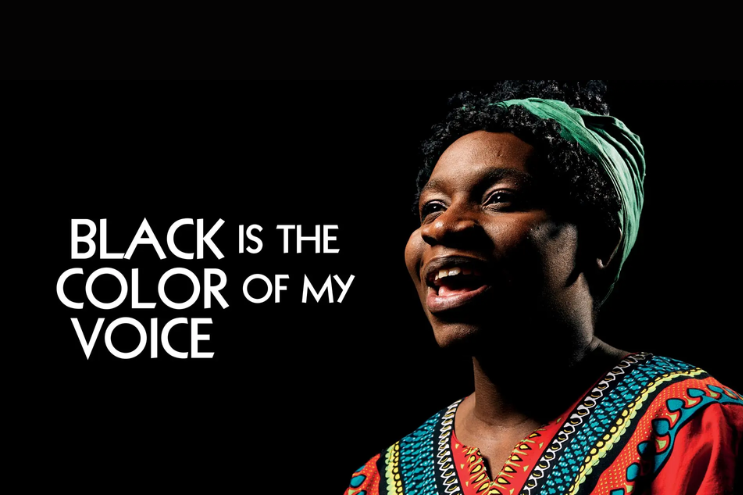
A love letter to one of the great performers of their time, Nina Simone.

Inspired by the life of Nina Simone, and featuring many of her most iconic songs performed live, Apphia Campbell’s acclaimed play ‘Black Is The Color Of My Voice‘ follows the life of the singer and civil rights activist as she seeks redemption after the untimely death of her father.
The show has toured the UK and Australia and played sell-out seasons in Shanghai, New York, Edinburgh and now, the West End of London, playing on Monday evenings at the Duchess Theatre (as well as on tour around the rest of the UK).

The Show
Nina Simone’s path from child prodigy to iconic voice of both jazz and justice was marked by extraordinary talent, profound struggle, and uncompromising conviction.
Born Eunice Waymon and raised with the expectation that her musical gifts would serve the church, she seemed destined for a life in classical piano.
With the help of a community fund in her hometown, she attended the Allen High School for Girls and later spent a formative summer at the Juilliard School, preparing for the next step she believed would shape her future: admission to the Curtis Institute of Music. When Curtis rejected her application (a decision she attributed to racial prejudice) her life swerved irrevocably.
To support herself, she took a job playing piano in an Atlantic City nightclub. Fearing her family’s disapproval for performing so-called “devil’s music,” she reinvented herself as Nina Simone. When the club insisted she sing as well as play, her voice revealed itself to the world.
Her debut album Little Girl Blue (1958) marked the beginning of a prolific career, followed by more than 40 albums over the next 16 years. Her 1959 recording of “I Loves You, Porgy” became her first major U.S. hit, establishing her place in the mainstream.
As the Civil Rights Movement surged, Simone’s artistry fused with activism. Her music became a vessel for protest, mourning, and fierce demand for change, securing her legacy as one of the era’s most resonant cultural forces.
Disillusioned by the political climate following Martin Luther King Jr.’s assassination, she eventually left the United States, making new homes in France, Liberia, and Barbados. Through the 1970s, ’80s, and ’90s, she continued to perform across continents, an artist unbound by borders, carrying her defiant truth wherever she went.
My Thoughts
There is a lot of heart and greatness to this play but also room for improvement.
As someone who was not completely versed in the life and work of Nina Simone, I found the story difficult to understand.
The timeline was confusing – at what point in her life was it set and why exactly was she enduring a three-day spiritual cleanse to try to make contact with her deceased father? Some of these questions are answered but if you are not familiar with the life of Nina Simone it can be difficult to follow.
Born Eunice Kathleen Waymon, in this play she changes her name to ‘Mena Bordeaux’, which I assumed was a stepping stone to creating the name she became famous for, Nina Simone. But upon reading after the show, it transpires this name change was a decision by writer/performer, Apphia Campbell to enable some creative freedom to explore Simone’s complex life and legacy.
In an interview she said:
“I took this name because I wanted to be able to use my own voice when I was singing but also to have a little bit of freedom in the writing. While all the facts in the story are historically accurate, there are things that I took my own liberties in terms of interpretation and trying to understand the mindset of Nina Simone in that time, in that situation. So in terms of the beats of her life, those things are historically accurate. How she responded in those situations and what she thought in those situations, those things are my interpretation of her.”
Black Is The Color Of My Voice has clearly grown over the years since it was written and toured around the world and it is a wonderful story that would work perfectly at the Edinburgh Fringe Festival with its no-frills staging.
But for a show so powerfully about music, the recorded backing tracks didn’t help to make the audience feel the emotion of the songs and I felt it was really missing the ambience of a small live band behind her.
Equally, I would have loved for some moments where Apphia was tinkering with some chords on a piano on stage, under-scoring her story every now and then.
Aside from the performance, I have to mention that this is a 75 minutes show with low production values. Performed on a West End stage once a week (on the night The Play That Goes Wrong does not play) the ticket price of between £30-£50 is high for what is effectively a black box show.
The West End has got crazy expensive over the past year with dynamic ticket pricing coming in to play but are shows like this starting to set a precedent for hour long summer shows at the Edinburgh festival to follow suit and raise their ticket prices?
Black Is The Color Of My Voice is a lovely piece of theatre and clearly a love letter to one of the great performers of their time but if I am to judge this by the West End ticket price, it needs a few more bells and whistles to make it more colourful.
★★★
West End Wilma
Black Is The Color Of My Voice plays next Monday 19 January and has announced two further performances on Monday 23 February Monday 2 March.
Tour Dates
13 – 14 January 2026 – Oxford Playhouse
19 January 2026 – Duchess Theatre, London
23 February 2026 – Duchess Theatre, London
02 March 2026 – Duchess Theatre, London
13 April 2026 – Queen’s Theatre, Hornchurch
14 April 2026 – Riverfront Arts Centre, Newport
15 April 2026 – Gloucester Guildhall
20 April 2026 – Theatre Severn, Shrewsbury
24 & 25 April 2026 – Leeds Playhouse
30 April 2026 – Parkhouse Centre, Bude
02 May 2026 – Cranleigh Arts Centre
15 – 18 July 2026 – Bristol Old Vic