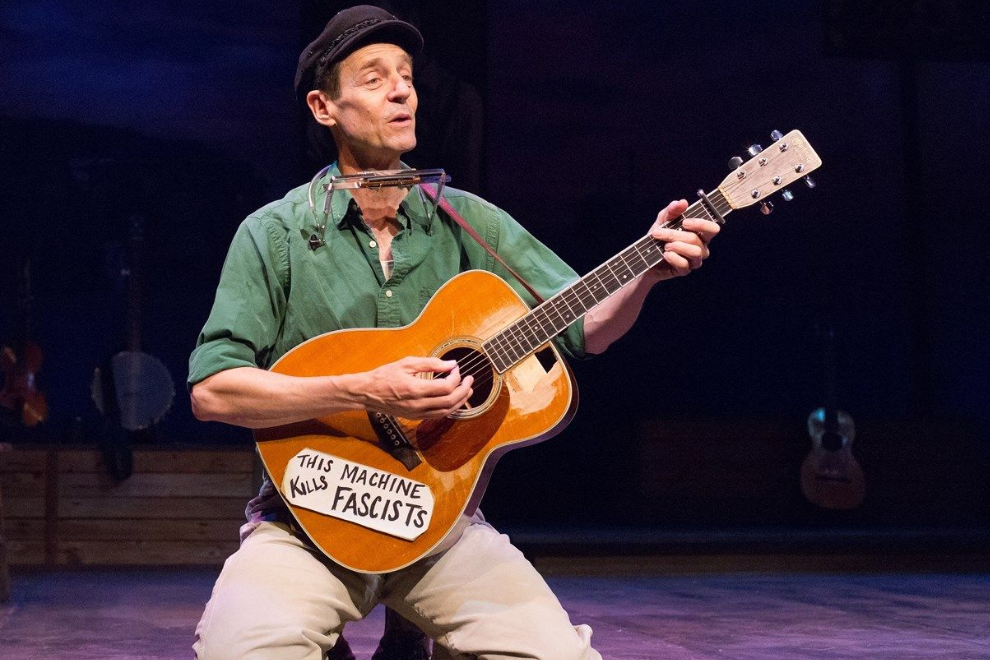
Woody Sez: The Life & Music of Woody Guthrie, the internationally celebrated musical built around the songs and writings of American folk icon Woody Guthrie plays at the Underbelly Boulevard from 8th – 19th September.
Having seen the show this year in Edinburgh, I wanted to find out more about the show from David M Lutken.
David M. Lutken, who reprises the role of Guthrie for this production, devised Woody Sez with original director Nick Corley and original cast members Darcie Deaville, Helen Jean Russell and Andy Tierstein, drawing from Guthrie’s autobiographical works including ‘Bound for Glory’ and ‘American Folk Song’, letters, diary entries and excerpts from Guthrie’s 1930s-40s newspaper column ‘Woody Sez’ to create a music-led portrait of one of America’s defining folk voices. Packed with live performances of Guthrie’s songs woven together with stories drawn from his life. The uplifting production captures the highs, hardships and restless spirit that shaped one of America’s most influential folk musicians.
Woody Sez has now travelled from its Fringe debut in 2007 to more than 80 productions around the world. Did you ever imagine the show would have such a long life when you first devised it?
The answer is “yes” and “no” – I’ve always thought that Woody’s songs and his story deserve to be told – and heard – around the world, but I don’t think I imagined that we would have the wonderful good fortune that “Woody Sez” has had in contributing to that goal.
The show draws on Woody Guthrie’s songs alongside his letters, diary entries, newspaper columns and autobiographical writing. How did you decide which parts belonged in the final piece?
Darcie, Helen, Andy, Nick and I all had opinions about what songs and which stories, columns and anecdotes would best tell Woody’s life – as far as anyone’s can be told on the stage. How biographical information is balanced with a narrative that sustains an emotional arc – all of it true and accurate and affecting – is a sort of Calculus: you can never get completely “there”, but you get close enough to see the answer.
You have played Woody Guthrie for many years and worked closely with his family and estate. Has your understanding of him changed as the show has continued to evolve?
Knowing members of Woody’s family, and having begun writing with their encouragement, as well as that of his former manager and friend, the late Harold Leventhal, has had a tremendous impact on the show and its evolution, and, yes, my own understanding of Woody Guthrie’s legacy. To extrapolate from my experience with “Woody Sez”: I’ve only been successful because of the help so many others have given me along the way.
To quote the man himself:
“I think back through my life to all the people that I owe, I mean the ones I can remember in person. I know that I owe these folk and they owe some other people, and these are in debt to others, and all of us owe everybody, and the amount that we owe is all that we have.”
Four actor-musicians share more than 20 instruments during the performance, passing them between one another as the story unfolds. How does that constant movement shape the energy of the show?
Woody played many different instruments: guitar, mandolin, fiddle, harmonica. Sometimes he danced while he played and sang, as many old time performers did (and some still do!) Multiply that by four and it generates a great deal of energy – something Woody and his compatriots were famous for.
Guthrie’s life took him from the Dust Bowl and union halls to radio and wartime service. How did you approach telling such a wide-ranging life within an 80-minute production?
Of course, it’s impossible to ‘tell’ anyone’s life in 80 minutes (and this version of “Woody Sez” is our edited “Fringe version” for the Underbelly).
The approach has been to find the truest and most revealing moments from his childhood in Oklahoma, his own ‘Dust Bowl Refugee’ peregrinations, his marriages, Merchant Marine service, his devotion to his children, and his battle with Huntington’s Disease – never to lose sight of his purpose and his message.
The show has been described as having the feel of a live folk session. What did you want that sense of communal music-making to bring to the way audiences experience Guthrie’s story?
Woody was all about communalism, and making music is one of the oldest and truest of human connections. We have Hootenannies wherever we go, inviting our audiences to come and play and sing along – The Underbelly Boulevard run will be no exception: each Thursday after the performance, at 8:45. We want the energy of the show – and of our ”hoots” – to remind folks of the joy and spirit of real “community”.
Guthrie’s music has influenced generations of musicians in very different genres. Which parts of his songwriting do you think have helped his work continue finding new listeners?
People appreciate Art in service of a social purpose. Every part of Woody’s songwriting – his humour, sarcasm, satire, commentary, story-telling, protest, pathos and his real patriotism will continue to stand as a crucial part of the very best of 20th century folk music. Along with many who came before, the lessons of his music, his spirit and his life will continue to inspire the next generations.
Woody Sez: The Life & Music of Woody Guthrie runs 8th- 19th September – 19:00 (15:00 & 19:00 Saturdays, 14:00 Sunday) | 80 mins – Underbelly Boulevard – 6 Walker’s Court, Soho, London, W1F 0BT. Tickets.