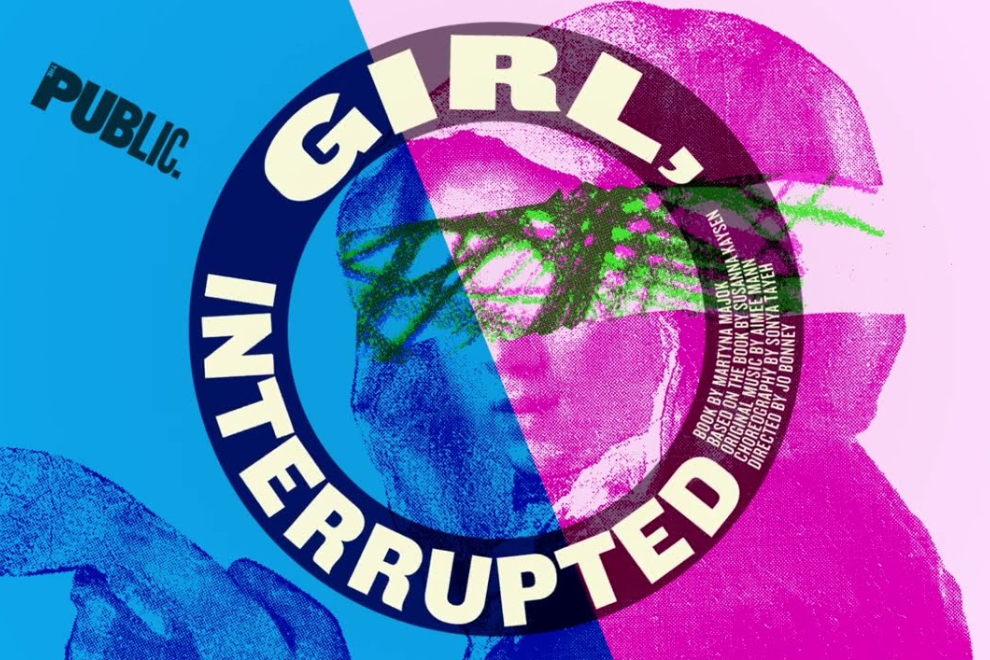
“Girl Interrupted has the potential to be one of the most important shows of the decade”
Susanna Kaysen’s 1993 memoir, Girl Interrupted, documented the eighteen months she spent in a psychiatric hospital following a suicide attempt.
It was turned into a box office hit in 1999, with Winona Ryder as Susanna, Angelina Jolie as the magnetic and terrifying Lisa, Brittany Murphy as Daisy, a then-unknown Elisabeth Moss as Polly, Clea DuVall, Jared Leto and Whoopi Goldberg.
For many people of a certain age, this story (in both its forms) arrived at exactly the right moment. It attracted those who felt different and misunderstood in the world.
So when I heard that Kaysen’s book had been adapted for the stage, with songs by Aimee Mann and that it was running at The Public Theater in New York, seeing it was a no-brainer.
The Story
Set in 1967 in McLean Hospital, Belmont, Massachusetts, a facility whose alumni include Ray Charles, James Taylor and Sylvia Plath, the show follows seventeen-year-old Susanna from the moment she swallows a bottle of pills and washes them down with a bottle of vodka.
After fifteen minutes with a doctor, she is put in a cab and sent to the ward, where she will spend the next eighteen months navigating her own fractured sense of self alongside a group of women whose stories are, in many ways, even more heartbreaking than her own.
Girl Interrupted has always been, underneath everything, a story about friendship forged in impossible circumstances, about the particular intimacy of shared suffering and about hope that persists even when it has very little reason to.
At its deepest, it is also a story about abuse: of self, and of others and the questions that hover over each character. Was Susanna driven to despair by her affair with her teacher? Is Daisy safer inside the hospital than outside it? Why did Polly do what she did? These are complicated and fascinating questions and all is material that wants to be explored. The show strains towards something bigger than it currently allows itself to be.
The Cast
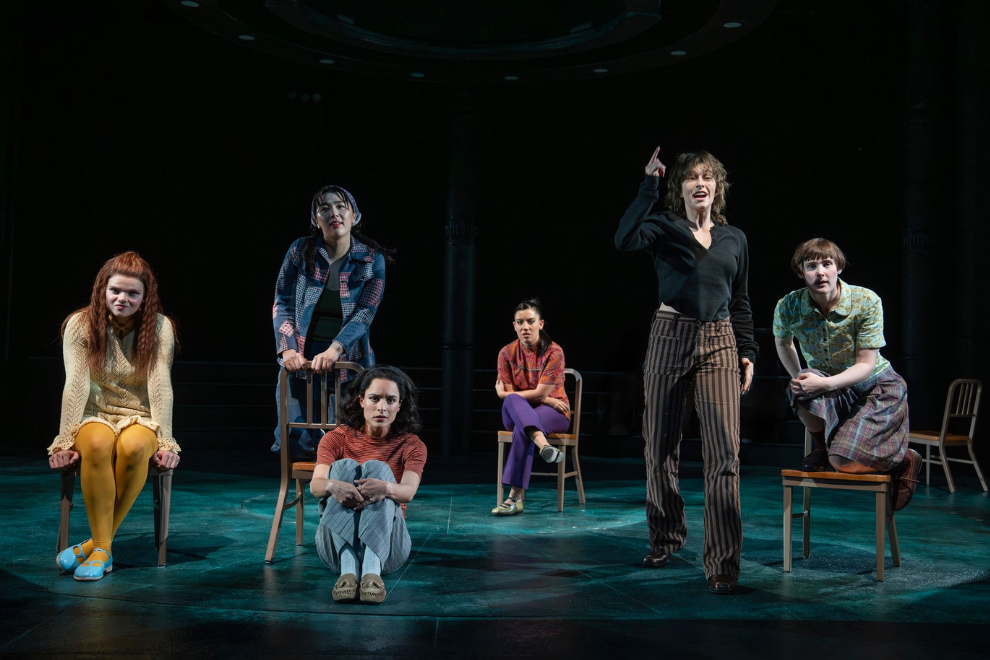
Juliana Canfield, fresh from her acclaimed run in Stereophonic on Broadway, plays Susanna with a stillness and an intelligence that is captivating. She has eyes that seem to let you look directly into the character. It is a controlled and quietly devastating performance and the show is safe with her in the centre of it.
King Princess takes on the role of Lisa, and brings considerable presence to it but the character feels somewhat reined in. Lisa, as written and as previously portrayed, is a force of nature: wild, dangerous, uncomfortably compelling. This version keeps her at a safer distance and while the performance is strong, you leave feeling the character’s full story was never quite unlocked.
The real revelation is Sally Shaw as Polly. Her portrayal of a young woman who set herself on fire as a child and the painful, fragile innocence she has preserved despite it is extraordinary. It is the kind of performance that makes you sit forward in your seat. One absolutely to watch.
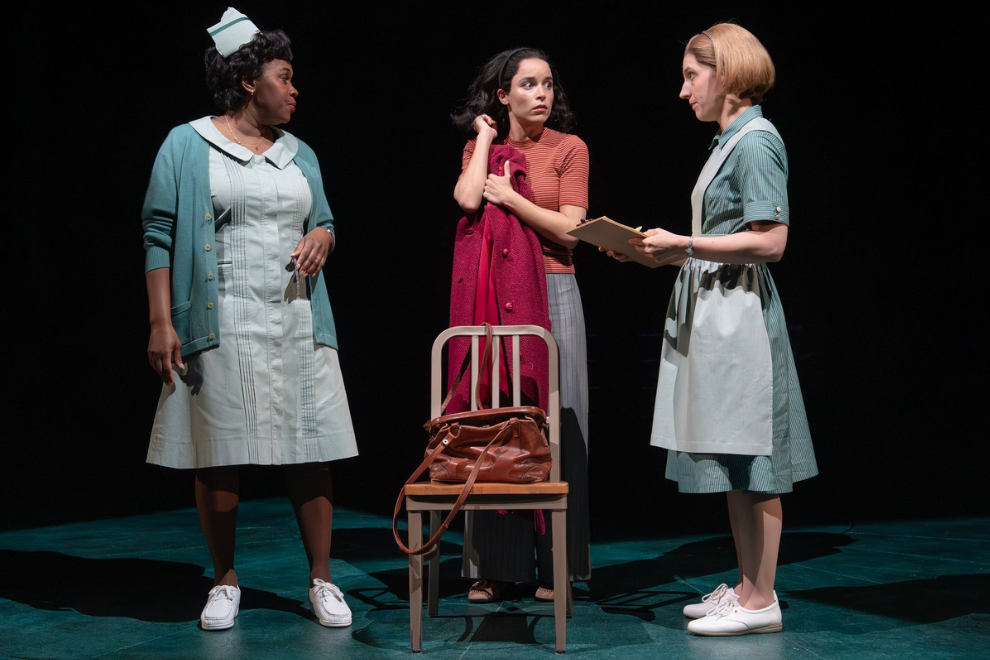
Ta’Rea Campbell as Valerie, the nurse who sees Susanna more clearly than she sees herself, doesn’t seem to connect to the other characters in the way you would hope a nurse would – making them feel like a friend with their best interests at heart.
Katherine Reis, Mia Pak and Gabi Campo as Daisy, Grace and Tori respectively, are all compelling in what they are given but therein lies the frustration. They are not given quite enough.
The Music
Aimee Mann‘s songs integrate naturally into the fabric of the story rather than interrupting it, which is exactly right for material this sensitive. There is a delicacy to the score that suits the world of the play. But Mann’s best work has a devastation to it and it feels as though the show has not yet fully found the moments where the music is allowed to cut as deep as it could.
Why bring Girl Interrupted to the stage now?
On paper, the answer should be obvious: mental health, the abuse of power, institutional failures, the way women’s pain is dismissed and contained, sadly these things are still painfully current.
And yet the production keeps the story firmly in 1967, without finding a way to bridge the gap between then and now. There is a version of this show that uses that distance brilliantly, that makes you feel the contrast between the clinical language of a 1960s psychiatric ward and the language we use today. And there is another version, equally valid, that updates the setting entirely and lets these themes breathe in a contemporary context.
There is also a version that goes further still. The scale of what is being explored here: suicide, sexual coercion, abuse, loss, identity, survival, are themes that could sustain five hours across two parts in the tradition of Angels in America. Going hard and deep on each individual story, giving every character the full weight they deserve.
Girl Interrupted the musical feels, in its current form, like the beginning of that show. A first draft of something that could be genuinely extraordinary.
I left wanting more. More time, more depth, more courage. The structure is there. The material is there. The cast is there. This is a show I wanted to love unreservedly and there are moments in Sally Shaw’s Polly, Juliana Canfield’s final scene and the quieter Aimee Mann numbers where I did. The rest of the time I sat in the dark willing it to trust itself.
This has the potential to be one of the most important shows of the decade but in its current state it feels like it was the depth of writing that was interrupted.
★★★
Reviewed by West End Wilma